On this page
Who sets shea butter grades?
Two published standards grade shea butter: the Codex regional standard CXS 325R-2017, and the African Organisation for Standardisation's ARS SHEA-B.12 Ghana also has a national standard, GS 238, but its limits are sold rather than published.3
Codex defines Grade I and Grade II, and covers food use only.1 ARSO defines Types 1, 2 and 3, covers food and non-food uses, and is the only standard we found that names cosmetics: Type 1 “can serve the needs of the cosmetic and pharmaceutical industries”.2
| Body | Standard | Grades it defines | Covers |
|---|---|---|---|
| Codex Alimentarius (FAO/WHO) | CXS 325R-2017, regional standard for Africa | Grade I, Grade II | Food only |
| African Organisation for Standardisation | ARS SHEA-B (2011) | Type 1, Type 2, Type 3 | Food, cosmetics, soap |
| Ghana Standards Authority | GS 238:2006/Amd 1:2014 | Limits not published free | Unrefined shea butter |
| American Shea Butter Institute | None (private testing body) | Letters A to F, as described by retailers | Not a recognised standard |
What the label says
“Grade A”
A letter attributed to a private US testing body. Retailers describe the scale differently, and no Codex, ARSO or Ghana standard uses it.
What to ask for instead
ARSO Type 1 limits
Four measured limits that a lab can test and a contract can enforce.
- Free fatty acids≤ 1.0%
- Peroxide value≤ 10 meq/kg
- Moisture≤ 0.05%
- Insoluble impurities≤ 0.09%
Where “Grade A” comes from
The letter grades are usually attributed to the American Shea Butter Institute, a private US body that tested samples for a fee. A 2008 university trip report notes that export companies used it for certification.9 Its own grade definitions are not published, and retailers describe the scale as A to F, A to E or A to C.
In 2015, before the Codex standard was adopted, CBI found there were “no industry-agreed grading systems” for shea.8 Codex now requires each container label to state the product name and its grade, consistent with its Table 1.1 That gives buyers something enforceable to ask for.
What limits define each grade?
Each grade is defined by the same four measurements: free fatty acids, peroxide value, moisture and insoluble impurities. ARSO Type 1 and Codex Grade I share the same top-grade limits.12
Free fatty acids (FFA)% m/m. Ask for it to be stated as oleic acid.
Peroxide value (PV)meq active oxygen per kg
Moisture% m/m
Zoomed in: 0.05% is one part in two thousand. ARSO Type 3 allows up to 2.0%, far off this scale.
Insoluble impurities% m/m
Same zoom. ARSO Type 3 allows up to 2.0%.
| Parameter | Type 1 / Grade I | Grade II / Type 2 | Type 3 | Test method |
|---|---|---|---|---|
| Intended use | Cosmetic, pharmaceutical, direct consumption | Food industry: confectionery, chocolate, margarine | Soap-making, or refining | – |
| Free fatty acids | ≤ 1.0% | 1.1 to 3.0% | over 3.0 to 8.0% | ISO 660 |
| Peroxide value | ≤ 10 meq/kg | 11 to 15 meq/kg | over 15 to 50 meq/kg | ISO 3960 |
| Moisture | ≤ 0.05% | 0.06 to 0.2% | over 0.2 to 2.0% | ISO 662 |
| Insoluble impurities | ≤ 0.09% | 0.1 to 0.2% | over 0.2 to 2.0% | ISO 663 |
Codex notes that its limits are broad on purpose, because they reflect “the actual variation in characteristics found in shea butter in all production areas”.1 Type 3 exists only in the ARSO standard.2
What FFA level is acceptable for export unrefined shea butter?
For cosmetic use, 1.0% or less. Food-industry buyers accept up to 3.0%. Butter between 3% and 8% FFA fits only ARSO Type 3, which is meant for soap-making or for refining before use.12 Peer-reviewed work on shea gives the same split: cosmetic and pharmaceutical buyers need FFA under 1% and peroxide value under 10.4
Why FFA rises
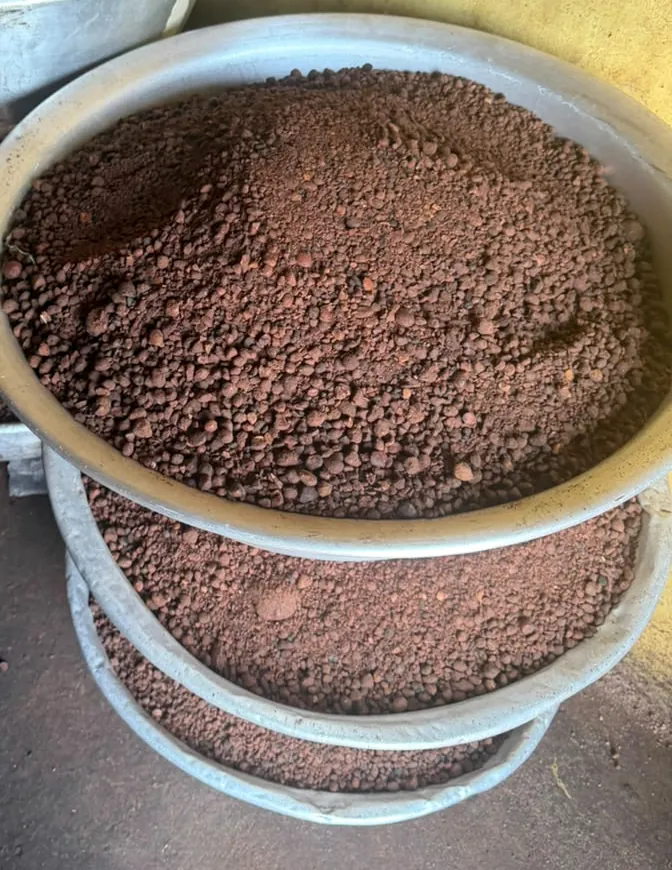
Free fatty acids form when the fat is broken down by water and natural enzymes (hydrolysis). Slow sun-drying of kernels and poorly controlled pre-treatment both raise FFA.4 In one study, longer kernel roasting raised FFA, while higher roasting temperatures lowered it by driving off moisture.5 That is why butter made by traditional methods varies so widely: published values run from 1.8% to 22.5% FFA.4
FFA “as oleic acid”
Codex doesn't state the basis, so name it in your contract to avoid argument later.
Acid value is about 2 × FFA
Both come from the same ISO 660 titration. As oleic acid, acid value (mg KOH/g) ≈ 1.99 × FFA %, so 1% FFA ≈ AV 2.0.
No date on the result
Agree whether the figure applies at loading or on arrival, and the tolerance for a retest at destination.
What peroxide value and moisture should cosmetic-grade shea have?
Peroxide value ≤10 meq O₂/kg and moisture ≤0.05%. Those are the ARSO Type 1 and Codex Grade I limits.12 The food-industry grade allows up to 15 meq/kg and 0.2% moisture.
Peroxide value measures hydroperoxides, the first products of oxidation. These break down into the aldehydes and ketones that smell rancid.54 So a low peroxide value on an old sample can mislead: oxidation may simply have moved on to the next stage.
A low peroxide value on an old sample isn't proof of freshness. Ask for the date of manufacture next to the result.
What the chemistry means for buyers
Moisture matters because water drives the hydrolysis that raises FFA. ARSO also sets volatile matter at 105 °C below 0.2% as an identity check.2
What to write on your specification instead of “Grade A”
Name the standard, state each limit with its unit and test method, and say when the result applies. Here is a cosmetic-grade specification built only from the published standards.126
Codex CXS 325R-2017 Grade I limits
| Parameter | Requirement | Method |
|---|---|---|
| Free fatty acids (as oleic) | ≤ 1.0 % | ISO 660:2020 |
| Peroxide value | ≤ 10 meq O₂/kg | ISO 3960:2017 |
| Moisture and volatile matter | ≤ 0.05 % | ISO 662:2016 |
| Insoluble impurities | ≤ 0.09 % | ISO 663:2017 |
| Iodine value (identity) | 30 – 75 g I₂/100 g | ISO 3961 |
| Saponification value (identity) | 160 – 195 mg KOH/g | ISO 3657 |
| Melting point (identity) | 35 – 40 °C | ISO 6321 |
| Sampling | Per lot | ISO 5555 |
Add these if the butter goes into food or baby care
What about refined (RBD) shea butter?
No standard sets grades for refined shea. Codex doesn't list shea among its named vegetable oils,8 so refined shea for food falls under the general standard for fats and oils, CXS 19-1981.7 That standard suggests a supplementary acid value of 0.6 mg KOH/g for refined fats, about 0.3% FFA. It is optional, but food buyers often use it. For cosmetics, refined shea is bought to the supplier's own specification, so ask for one with limits, methods and dates.
Questions buyers ask next
Is Codex Grade I the same as cosmetic grade?
The limits are the same, but the scope differs. Codex covers food use only. ARSO Type 1 has identical limits and is the grade the standard names for cosmetic and pharmaceutical use, so quote ARSO Type 1 on a cosmetic specification.
Does Ghana have its own shea butter standard?
Yes. The Ghana Standards Authority publishes GS 238:2006/Amd 1:2014, “Specification for Shea Butter (Unrefined)”. Its limits are in the purchased standard rather than online, so ask a Ghana supplier whether their butter is certified to it.
Is the American Shea Butter Institute a standards body?
No. It is a private US testing body, and its letter grades are not recognised by Codex, ARSO or the Ghana Standards Authority. Use the published limits instead.
Which test methods should a shea butter COA name?
ISO 660 for free fatty acids and acid value, ISO 3960 for peroxide value, ISO 662 for moisture and ISO 663 for insoluble impurities. FOSFA's contractual methods list the current editions: ISO 660:2020, ISO 3960:2017, ISO 662:2016 and ISO 663:2017.
How do I convert acid value to FFA?
Expressed as oleic acid, FFA % ≈ acid value ÷ 1.99. So an acid value of 2.0 mg KOH/g is about 1% FFA.
Where these facts come from
Every figure on this page is linked to the body that publishes it. We checked each source on 14 November 2026.
- Regional Standard for Unrefined Shea Butter (Africa), CXS 325R-2017Codex Alimentarius (FAO/WHO). Adopted 2017, amended 2020 and 2022
- ARS SHEA-B (2011) African standard for shea butter (unrefined)African Organisation for Standardisation (ARSO), via Public.Resource.Org
- Catalogue of Ghana Standards (lists GS 238 for unrefined shea butter)Ghana Standards Authority
- Cooking and drying process optimisation of shea butter extractionNsogning Dongmo et al., Czech Journal of Food Sciences 32(6), 2014
- Influence of roasting of shea kernels on their fat content and some quality characteristics of shea butterHonfo et al., Journal of Food Studies 6(1), 2017
- Contractual Methods of AnalysisFOSFA International, April 2022
- Standard for Edible Fats and Oils not Covered by Individual Standards, CXS 19-1981Codex Alimentarius (FAO/WHO), amended 2024
- CBI Product Factsheet: Shea Butter in EuropeCBI, Netherlands Ministry of Foreign Affairs, 2015
- Trip report, Mali (USDA Higher Education Challenge Grant)Montana State University, 2008, revised 2010